> For the complete documentation index, see [llms.txt](https://mapir.gitbook.io/daq/llms.txt). Markdown versions of documentation pages are available by appending `.md` to page URLs; this page is available as [Markdown](https://mapir.gitbook.io/daq/daq-e/daq-e-user-manual.md).
# DAQ-E User Manual
This user manual describes the DAQ-E IP67 Ethernet spectroradiometer
The DAQ-E is an IP67 waterproof, radiometrically calibrated Ethernet spectroradiometer, built for permanent outdoor installations. It records the ambient light spectrum from **340 – 1010 nm** as **135 measurements** (one every 5 nm) in absolute irradiance units (**W/m²·nm**), streaming to the network at up to **10 Hz**.
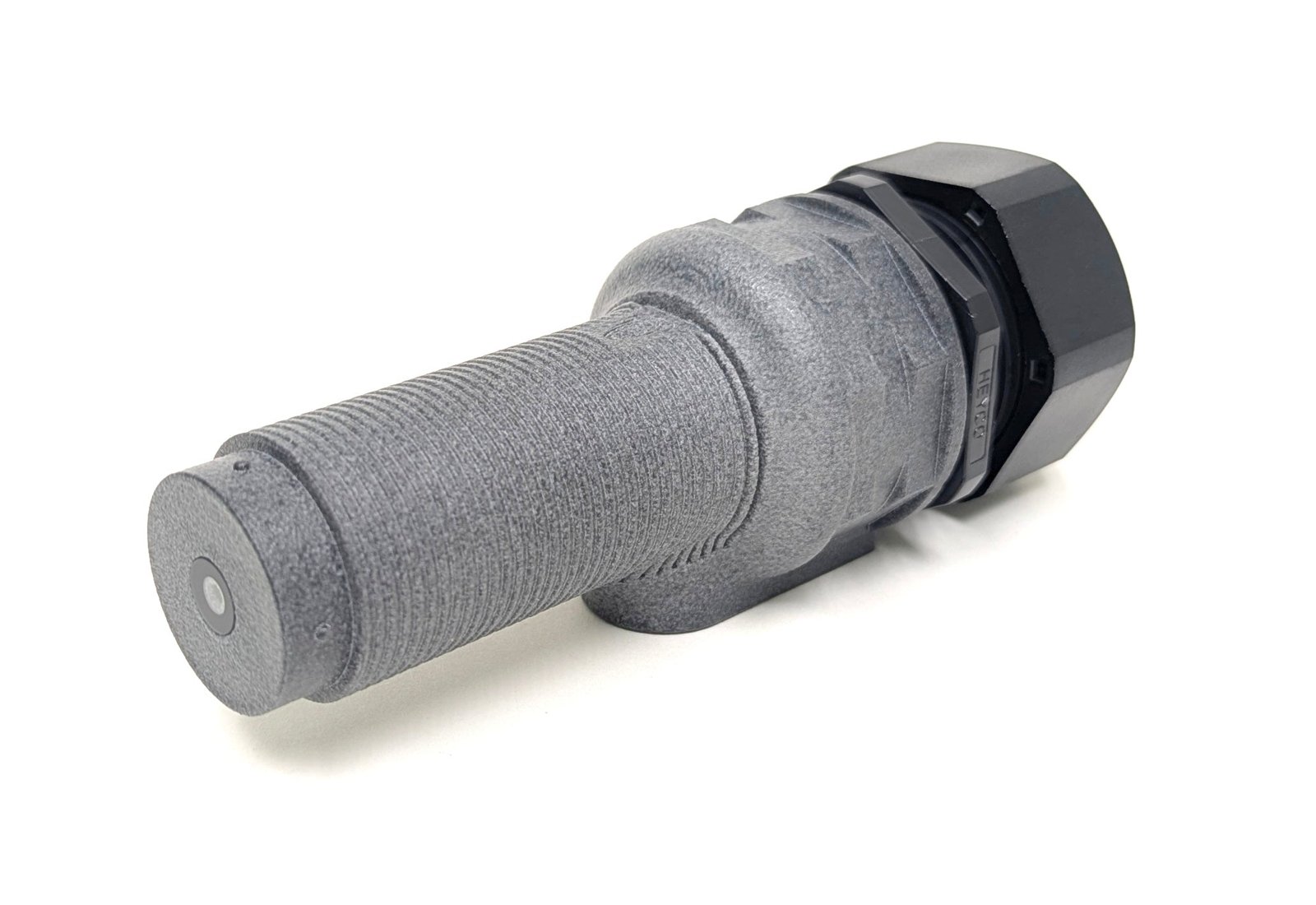
The DAQ-E: sensor end (left) and the waterproof Ethernet cable gland (right)
A single Ethernet cable carries both power and data using **Power over Ethernet (PoE)** — there is no battery to charge and no memory card to download. This makes the DAQ-E well suited to rooftop and field stations, long-term environmental monitoring, and real-time reflectance measurements with [LATTICE cameras](https://www.mapir.camera/pages/multispectral-cameras).
The DAQ-E contains the same radiometrically calibrated light sensor as the [DAQ-U](https://mapir.gitbook.io/daq/daq-u/daq-u-user-manual.md) (USB-C) and [DAQ-M](https://mapir.gitbook.io/daq/daq-m/readme.md) (Bluetooth). All three speak the same protocol and produce the same `.daq` data file — the DAQ-E is the networked, waterproof, permanently-installed variant.
## How It Works
The DAQ-E connects to a PoE-capable network. Once powered, it appears on the local network and streams to Chloros (or your own software) over Ethernet. It advertises itself over mDNS so Chloros can discover it automatically, and it can broadcast to multiple consumers at once or stream to a single client. See [Network Setup](https://mapir.gitbook.io/daq/daq-e/network-setup.md) for addressing, discovery, and streaming modes.
Because the DAQ-E and MAPIR LATTICE cameras can share a common clock, spectral measurements can be aligned to individual camera frames. See [Time Synchronization](https://mapir.gitbook.io/daq/daq-e/time-synchronization.md).
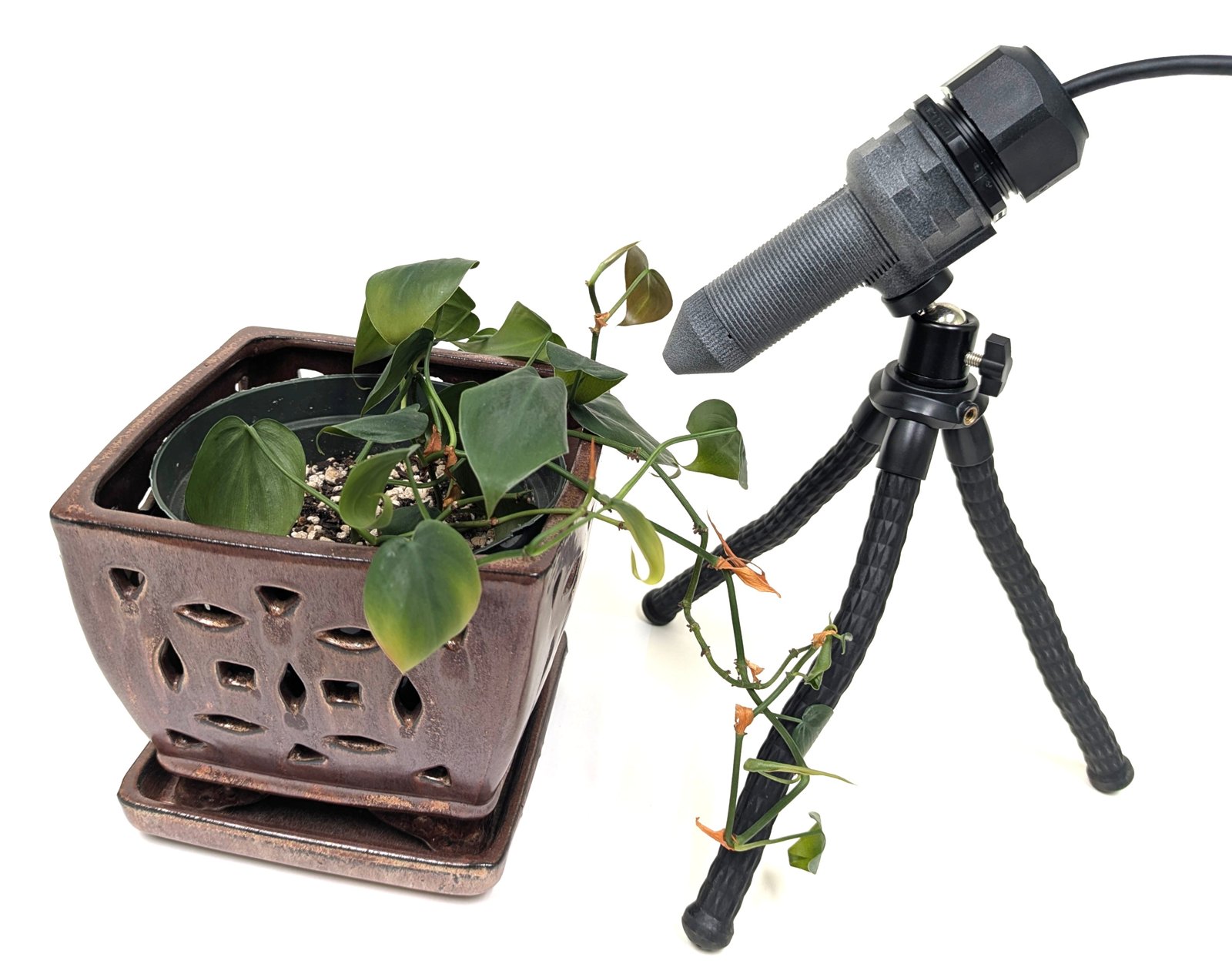
The DAQ-E on a tripod, measuring plant-canopy lighting
## Radiometric Calibration
Every DAQ-E ships with a unique, per-unit radiometric calibration certificate ([view an example](https://cdn.shopify.com/s/files/1/0878/4732/files/daq-e_example_calibration_certificate.pdf?v=1783039610)) that is stored onboard the device. Chloros reads that calibration and applies it to every measurement, so the sensor produces absolute, repeatable results and can operate without an internet connection. After the factory calibration the DAQ-E never needs to be recalibrated.
## Caps
Like the DAQ-U, the DAQ-E ships without a cap and accepts snap-on caps that change the light path: the **Sunshine** cosine-corrector cap for ambient / downwelling irradiance, and **15° / 45° / 90°** field-of-view caps for measuring reflected light from a target. The bare sensor remains IP67 waterproof and is used for low-light environments.
Chloros cannot see which cap is fitted, so name it in the sensor's settings in Chloros (**None (bare sensor)** if no cap is fitted). A DAQ-E connected without a cap named is recorded with the Sunshine cap assumed; from Chloros 1.3.0 the recording says so, and processing warns about it. See [Caps & Mounting](https://mapir.gitbook.io/daq/daq-e/caps-and-mounting.md).
## DAQ-E-S
The DAQ-E-S is a DAQ-E with two differences. Chloros supports it from version 1.3.0; discovery, connecting, PTP time sync and recording work as they do for a DAQ-E.
* **Its Sunshine cap is fitted permanently.** The cap was on the unit when its factory calibration was measured, so the calibration already includes it. Chloros applies no cap correction to a DAQ-E-S and offers no cap to choose for it: its settings show none, and a cap set for the whole project does not apply to its recordings.
* **It has a built-in accelerometer.** The Sunshine cap's cosine correction holds only while the diffuser is level, and a tilted sensor reads the wrong irradiance with nothing in the spectrum to show it. Each DAQ-E-S reading therefore carries the unit's tilt, roll and pitch, and a `.daq` recorded from it stores them beside every spectrum.
For the recorded fields, see the DAQ-E-S section of the [Chloros CLI Reference](https://mapir.gitbook.io/chloros/reference/cli-reference) in the CHLOROS manual.
## Capturing Data
{% content-ref url="/pages/rflDiGDz2YW3AmFFscKz" %}
[Capturing Light Sensor Data](https://mapir.gitbook.io/daq/daq-e/capturing-light-sensor-data.md)
{% endcontent-ref %}
## Specifications
| Specification | Details |
| --------------------------------- | --------------------------------------------------------- |
| Dimensions | 160 x 57 x 57 mm (L x W x H) |
| Weight | 165.48 g (169.02 g with Sunshine cap) |
| Ingress Protection | IP67 waterproof |
| Operating Temperature | 0 °C – 60 °C |
| Spectrometer Calibration | Radiometric (W/m²·nm) |
| Calibration Certificate | Per-unit PDF (stored onboard, downloaded via Chloros) |
| Onboard Calibration Storage | Yes — calibration + certificate stored on device |
| Wavelength Range | 340 – 1010 nm |
| Number of Wavelength Measurements | 135 |
| Wavelength Measurement Width | 5 nm |
| Measurement Power Range | 20 – 150,000 Lux |
| Signal to Noise Ratio | 250:1 @ max. power & average of 40 |
| Dynamic Range | >1000:1 |
| Linearity | 99% |
| Integration Time | Auto or Manual (4 ms – 500 ms) |
| Streaming Rate (maximum) | \~10 Hz |
| Power | Power over Ethernet (PoE) only — no internal battery |
| Memory | None (streams over Ethernet) |
| Interface | Ethernet (IPv4), field-serviceable waterproof cable gland |
| Software | Chloros (Windows, Linux) |
## In the Box
* 1x DAQ-E spectroradiometer
* 1x Radiometric calibration certificate (digital — stored onboard, downloaded via Chloros)
Caps, Ethernet cables, and PoE equipment (injector or switch) are sold separately.